

Hazardous Materials Assessment
Commercial asbestos audits & hazardous material inspections

The handling of hazardous materials such as asbestos and other regulated wastes is subject to strict controls to protect human health and the environment.
Atma provides hazardous material assessment and management services, with particular expertise in asbestos contaminated soils, asbestos remediation oversight and workplace air monitoring.

Our independent and rigorous scientific approach supports workplace safety, regulatory compliance and safe redevelopment outcomes.
Backed by decades of experience in contaminated land and air quality management, Atma brings together environmental scientists, occupational hygienists and licensed removalists to provide a coordinated approach to hazardous material assessment, monitoring and management.
What we do
We bring our project management experience and industry knowledge, together with our services in hazardous materials assessment, remediation oversight, contractor management, air fibre monitoring and asbestos clearance certificates to provide turn-key solutions for asbestos contaminated sites.
Asbestos Soil Remediation
Asbestos contamination presents significant environmental, health and financial risk due to the complexity of containment, removal and disposal. Atma has decades of experience delivering remediation projects involving asbestos contaminated soils resulting from improper disposal practices and the demolition of asbestos-containing structures.
The remediation of asbestos contaminated soil requires a multidisciplinary approach. Our in-house hygienists, environmental scientists and experienced project managers oversee remediation works from planning through to validation, including management of licensed asbestos removalists, air fibre monitoring, quantity verification, site validation, and compliance with regulatory and safety requirements.
When is asbestos soil remediation required?
- When asbestos contaminated soil is identified during site investigations or demolition works
- Prior to redevelopment of contaminated land
- Where asbestos containing materials have been improperly disposed of onsite
- To satisfy EPA, council or occupational health and safety requirements
- Where demolition activities have caused asbestos contamination to surrounding soils
Hazardous Materials Audits
Under the Occupational Health & Safety Act 2017 an employer or a person who manages or controls a workplace has a duty to ensure that all asbestos containing materials present in a workplace are identified and appropriately managed. A hazardous materials audit and register of findings is by law required for any commercial building built prior to 2004. Atma provides asbestos audits and registers to maintain compliance, reduce liability, and protect the health of workers and building occupants. Audits involve visual inspections, historical research and sampling.
Division 5 Hazardous Materials Audit & Register
A non invasive inspection to identify accessible asbestos, assess risk and create a register.
Division 6 Hazardous Materials Audit & Register
An invasive inspection required for demolition or refurbishment. It identifies any concealed hazards, including materials in walls, cavities, subfloors or underground soil, including:
- Asbestos (friable and non-friable)
- Synthetic mineral fibres
- Lead-based paints
- Polychlorinated biphenols (PCBs)
When is a Hazardous Materials Audit required?
- As a requirement for all commercial building built prior to 2004 and reviewed every 5 years
- In response to an application for demolition or a building permit
- Before any physical works disturb the fabric of a commercial building built prior to 2004
Asbestos Contamination Management & Compliance
In some situations where asbestos contamination is identified, excavation and removal may be impractical, costly or create unnecessary disturbance risk. In these cases, a specialised management strategy is required to safely contain asbestos materials and prevent fibres from becoming airborne.
Where appropriate, containment and ongoing management can allow projects to proceed safely and compliantly while reducing remediation costs and long-term environmental liability.
Atma provides specialised asbestos management services for sites where asbestos contaminated soil can be safely managed in place. This may include capping contaminated areas with uncontaminated fill and preparing an Asbestos Management Plan (AMP) to support the safe containment and long-term management of asbestos materials remaining onsite.
Services may also include hazard mapping, installation of barriers and warning markers, and ongoing audit and monitoring programs.
When is an Asbestos Management Plan required?
An Asbestos Management Plan (AMP) may be required where asbestos contaminated soil remains onsite and requires ongoing management to ensure safety and regulatory compliance. Common situations include:
- Asbestos contaminated soil is identified but can be safely managed in place
- Excavation or removal would create unnecessary disturbance risk or excessive cost
- Redevelopment works require long-term contamination controls and monitoring
- Contaminated areas are being capped or isolated from future disturbance
- Ongoing management is required to satisfy EPA, council or occupational health and safety obligations
Contractor & Construction Support
Atma provides independent technical support to site owners, developers and contractors to reduce environmental liability and maintain health and safety standards during asbestos remediation works. Services include technical oversight, risk management and compliance auditing throughout the remediation process, providing protection against contractor errors, delays, and unexpected costs.
Prior to asbestos removal works being undertaken, contractors are required to prepare an Asbestos Removal Control Plan (ARCP). Under the Occupational Health and Safety Act 2017, this plan must be reviewed by an independent environmental consultant. Atma reviews ARCP documentation to ensure proposed works are safe and compliant with regulatory requirements, and provides onsite environmental oversight during remediation activities.
Asbestos Clearance Certificate
During asbestos remediation works, Atma acts as an independent licensed assessor to inspect remediation activities and verify that contaminated areas have been safely remediated and are suitable for construction and redevelopment works to proceed.
Clearance certificates certify that the area has been cleared of asbestos, there is no residual dust, air monitoring has shown no detectable asbestos fibres, the removal work was carried out safely, and the end result completely satisfies the requirements of workplace health and safety law.
Following inspection, we prepare Asbestos Clearance Certificates for clients and contractors to satisfy regulatory requirements and support ongoing site works.
Asbestos Air Monitoring
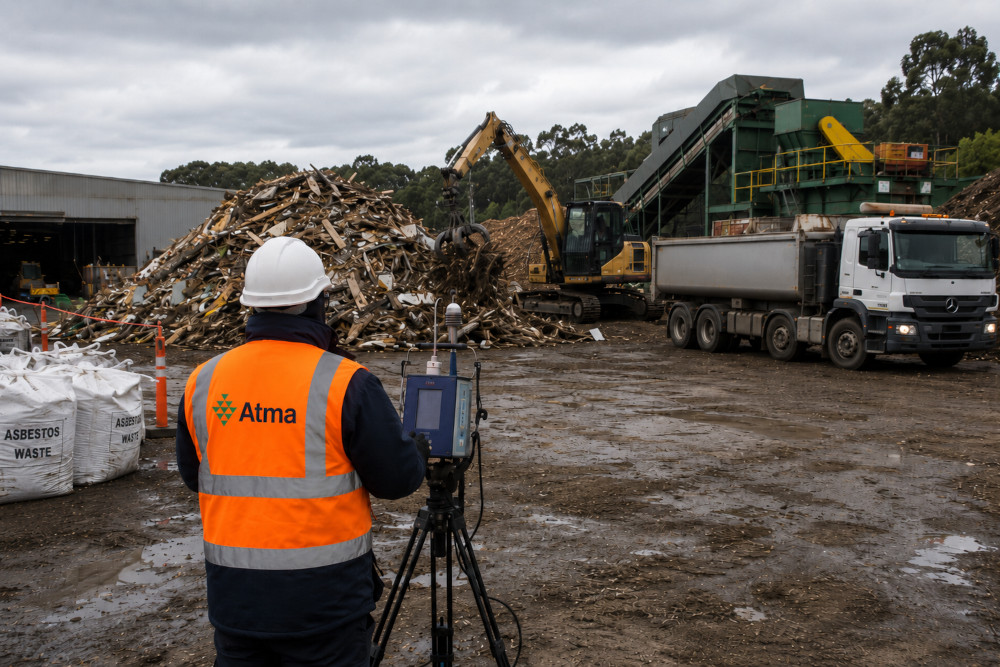
Air monitoring is a legal requirement during any removal works liable to generate respirable fibres (Class A orB). Atma acts as an independent assessor throughout the removal process, conducting air monitoring to verify asbestos removal control plans are working effectively – protecting workers and the surrounding environment
We establish baseline air monitoring prior to removal works commencing and continue monitoring throughout remediation and following site clean-up and clearance. This provides confidence that workers, site occupants and the surrounding community remain protected throughout the process.
Our Process
Hazardous materials assessment, monitoring and remediation requires careful planning, specialist oversight and strict regulatory compliance.
While the scope of each project varies, our services follow a consistent and proven process.
We assess the nature, location and extent of hazardous materials and identify potential risks to workers, the public and future site use.
We determine regulatory obligations and develop practical management, monitoring or remediation strategies appropriate to the site and project requirements.
Where remediation is required, we provide technical oversight, contractor support, air monitoring and compliance management throughout the works.
We verify remediation outcomes through inspection, monitoring and site validation, providing the documentation and certifications required to satisfy regulatory obligations.
Where hazardous materials remain onsite, we establish management plans, monitoring programs and ongoing compliance measures to support safe long-term site use.
Over 30 years protecting workers, communities and projects from hazardous material risk.
Case Study
Asbestos in Soil Remediation for Residential Development, Major Land Development, Aintree, VIC
The Challenge
Early works for residential development encountered bonded asbestos-containing material (ACM) at a former farmyard and dwelling area. Subsequent investigation identified ACM, building debris, and lead and zinc impacts requiring remediation before the land could be considered suitable for sensitive use.
Our Approach
Atma completed a targeted soil investigation, asbestos assessment and remediation strategy, including historical review, test pitting, soil sampling, asbestos identification, waste categorisation and recommendations for licensed removal, air monitoring, validation and clearance.
Delivery
Atma directed and supervised the licensed asbestos removal contractor, completed air monitoring, visual clearances, validation sampling, waste tracking and final condition reporting. Works included removal of ACM, vegetation, surface waste, contaminated soil and an unexpected burial pit.
Outcome
The remediation program removed asbestos, rubble, vegetation and lead/zinc-impacted soils from the subject area. Validation sampling confirmed residual concentrations were below adopted ecological and human health criteria for residential land use, while visual clearance confirmed no visible ACM remained on the ground surface within the remediation areas. Atma also prepared an Asbestos Management Plan to manage any future minor ACM finds during development works. The project demonstrates Atma’s capability in asbestos-in-soil assessment, sensitive-use remediation, licensed contractor supervision, air monitoring, validation, waste documentation and practical risk management for large residential development projects.

Latest Projects
Trusted on complex environmental management and compliance projects across all government, education, infrastructure, commercial and industrial sectors.
FAQs
Who is responsible for maintaining a hazardous materials register?
The answer depends on the specific circumstances of the property, workplace and tenancy arrangements. In many cases, responsibility may sit with the building owner, the occupier, or both, depending on who has management or control of the workplace and the building itself.
For example, a building owner may retain responsibility for hazardous materials contained within the building fabric, while a tenant or business operator may have obligations relating to workplace safety and the management of risks associated with those materials. Lease agreements, management arrangements and the ability to undertake building works can all influence how responsibilities are allocated.
Because obligations can vary, it is important that building owners, employers and facility managers understand their respective responsibilities and ensure that any hazardous materials register is current, accurate and available to workers and contractors.
Atma assists property owners, facility managers, schools, government agencies and businesses by undertaking hazardous materials audits, preparing compliant registers and providing advice on the management of hazardous materials in accordance with applicable regulatory requirements.
What happens if asbestos is discovered during construction works?
If suspected asbestos-containing material is discovered during construction, demolition or excavation works, the affected area should be isolated and work in the immediate vicinity stopped until the material can be properly assessed. Continuing works without appropriate investigation can increase the risk of asbestos fibre release, expose workers to health risks and create additional regulatory and project complications.
Once identified, the material should be assessed by a suitably qualified professional to determine whether asbestos is present and what management or removal measures may be required. Depending on the circumstances, this may involve asbestos sampling, air monitoring, preparation of management procedures, engagement of a licensed asbestos removal contractor or validation of the completed works.
Unexpected asbestos discoveries can result in project delays and additional costs, particularly where contamination has been disturbed or spread. Early assessment and prompt management are critical to protecting worker safety, maintaining regulatory compliance and minimising impacts on project timelines.
Atma assists clients by undertaking asbestos assessments, air monitoring, remediation oversight and regulatory support to help manage asbestos discoveries safely, efficiently and in accordance with applicable requirements.
Do I need a hazardous materials audit before demolishing or renovating a building?
In many cases, yes. Before demolition, refurbishment or maintenance works are undertaken, it is important to understand whether hazardous materials such as asbestos-containing materials are present within the building. Identifying these materials early helps protect workers, maintain compliance with regulatory requirements and avoid unexpected project delays.
A hazardous materials audit identifies the location, type and condition of hazardous materials that may be affected by the proposed works. This information can then be used to develop appropriate management or removal strategies before construction activities commence.
The audit also provides valuable information for demolition contractors and remediation specialists, allowing them to accurately scope works and prepare more reliable quotations. By understanding potential hazards early, property owners and project teams can better manage costs, reduce risks and plan works more efficiently.
Atma provides hazardous materials audits, asbestos assessments, remediation advice and compliance support to help clients safely manage demolition, refurbishment and redevelopment projects.