

Environmental Site Assessments
Preliminary & detailed site assessments and audits for Victorian contaminated land projects

Potential site contamination is a fundamental concern in all Victorian land development and must be properly understood and managed for projects to proceed.
Our environmental site assessments are based on thorough research and a wealth of past experience. We provide the information and advice needed to evaluate project risk, inform decision making, support planning approvals and other regulatory/corporate requirements.

Atma undertakes site assessments across a wide range of commercial, industrial and government development projects – from Preliminary and Detailed Site Investigations (PSI & DSI), to Hydrogeological and Soil Vapour Assessments, as well as assessments for Environmental Audits.
With experience across thousands of Victorian sites over 30 years, we understand the conditions, risks and regulatory expectations that move projects forward – providing clear, practical advice.
What we do
Preliminary Site Investigation, PSI (Phase 1 ESA)
A Preliminary Site Investigation assesses the likelihood of contamination through site history research, a site inspection by an experienced environmental scientist, and targeted, limited sampling where required.
The outcome is a clear, practical report that identifies potential risks and whether further investigation or remediation is likely to be required.
When is this required?
- Prior to purchasing potentially contaminated land
- For many types of planning permit applications, such as for subdivision or rezoning
- Environmental Audit overlays (EAOs)
Detailed Site Investigation (DSI) (Phase 2 ESA)
A Detailed Site Investigation is undertaken where a Preliminary Site Investigation identifies a potential risk of contamination. It involves systematic and targeted sampling and analysis of soil and groundwater (and in some cases vapour) to assess the presence and extent of contamination.
The outcome is a clear understanding of site conditions, supported by recommendations for management, remediation, or further assessment where required
When is this required?
- Where the site history (from PSI) identifies a potential contamination risk.
- Where Duty Holders have a Duty to Manage.
- To meet the regulatory requirements for planning permits, or environmental audits (Council or EPA)
- When a change to a more sensitive land use is proposed (e.g. residential or childcare)
- For informing pre-leasing, or lease exit obligations
Environmental Audit Assessment
An Environmental Audit is an independent assessment conducted by an EPA-accredited Environmental Auditor to determine whether a site is suitable for its intended use. The audit process requires the collection of accurate, dependable and detailed site investigation data, including sampling and analysis of soil, groundwater and vapour.
Atma supports the audit process by planning and undertaking site investigations, preparing documentation, and working closely with the appointed auditor to progress the site towards approval.
When is this required?
- As a requirement for certain planning permits (e.g. Environmental Audit Overlay applies).
- When required to do so by Council or EPA under the Environment Protection Act
- For sites with a history of contamination or higher risk and uses
- When changing from a less sensitive to a more sensitive land use (e.g. residential, childcare)
Vapour & Landfill Gas Assessment
Contaminants in soil or groundwater may generate vapours that can migrate into buildings and pose a risk to human health. The vapour investigation involves sampling of the subsurface atmosphere to identify volatile contaminants such as hydrocarbons, solvents and other hazardous compounds.
A landfill gas risk assessment is similar, but evaluates the presence, distribution and potential impact of methane and other gases associated with former or existing landfill sites.
When is this required?
- Where development is proposed within 500 metres of a former landfill
- Where site history indicates the potential for volatile contaminants in soil or groundwater
- Where there is a risk of vapour intrusion into buildings
Hydrogeological/Groundwater Assessment
A hydrogeological assessment evaluates if the occurrence of groundwater poses a risk to a development, and whether a proposed development might impact groundwater. It considers the depth of groundwater, details about the proposed works, groundwater flow and quality to identify potential risks and inform appropriate management strategies.
Groundwater contamination assessments are an important part of site contamination investigations. Groundwater contamination assessments focus on the nature and extent of groundwater pollutants and their effect on human health and the environment.
When is this required?
- As part of subdivision or planning permit applications
- To support residential or sensitive land use developments, such as for environmental audits
- To meet EPA or other regulatory authority requirements
- For mandatory groundwater monitoring (e.g. landfill sites, groundwater quality management plans)
Soil Hygienist Report
When is this required?
- For Victorian School Building Authority (VSBA) Building Blocks grant applications
- When importing soil or mulch to schools or early childhood facilities (as required by the Department of Education)
- To support planning permits or environmental audits (EPA or Council)
- When changing land use to a more sensitive use (e.g. residential, childcare)
Our Process
Site assessments and investigations can introduce uncertainty into a project. We provide a clear, structured pathway forward – giving you confidence in your site conditions, your obligations, and the next steps required.
While the scope of each project varies, our investigations follow a consistent, proven process
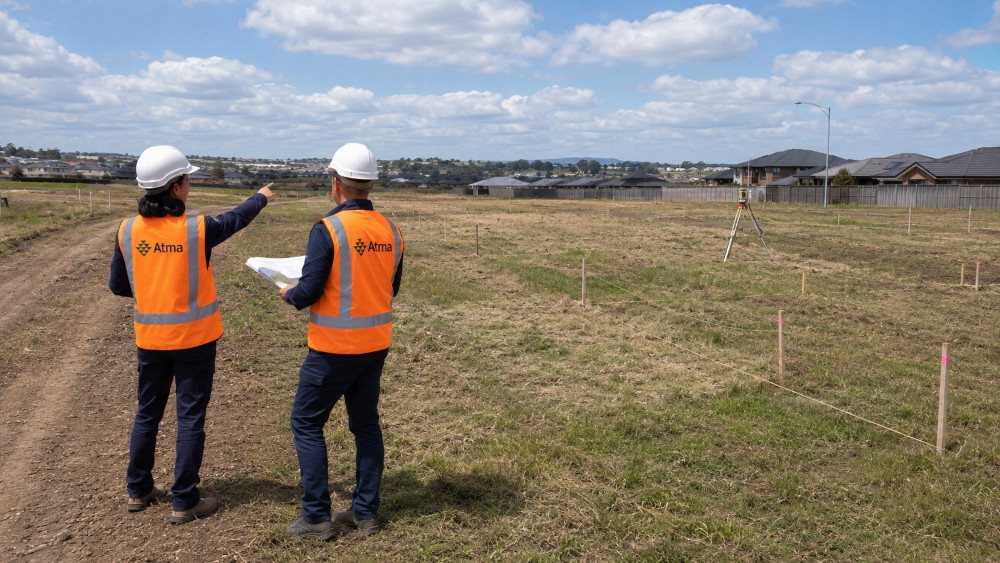
Our environmental consultants plan and carry out a site investigations designed to meet your specific project objectives.
Supporting commercial, residential, industrial and government site assessment projects across Victoria.
Case Study
A Complex Chlorinated Hydrocarbon Investigation & Remediation Project, Cheltenham, VIC
The Challenge
A former dry-cleaning site proposed for high-density residential redevelopment required detailed assessment of chlorinated hydrocarbon impacts in soil, groundwater and vapour to support a statutory Environmental Audit.
Our Approach
Atma delivered a staged PSI, DSI, soil vapour investigation, groundwater assessment, remediation feasibility study, remediation action plan and soil disposal assessment, in consultation with the environmental auditor.
Delivery
The investigation included on and off-site soil bores, groundwater monitoring wells, soil vapour probes, multiple monitoring events and targeted laboratory analysis to characterise contamination and inform an integrated remediation strategy.
Outcome
Atma developed a practical remediation framework that aligned with the proposed basement excavation, allowing source removal to be integrated with future construction. The project characterised complex PCE/TCE impacts, assessed vapour intrusion risks, managed asbestos-impacted fill and supported the statutory audit pathway for sensitive residential redevelopment. This project demonstrates Atma’s capability in chlorinated solvent assessment, vapour risk assessment, groundwater investigation, environmental audit support and remediation planning for complex brownfield redevelopment sites.

Latest Projects
Trusted on complex environmental management and compliance projects across all government, education, infrastructure, commercial and industrial sectors.

FAQs
When is an environmental site assessment required?
An environmental site assessment may be required where there is potential for contamination to affect the proposed use or development of a site. Requirements vary depending on the site’s history, the proposed land use, planning controls and the specific requirements of the relevant authority.
Environmental site assessments are commonly triggered by:
Applications for planning permits
Property subdivisions
Rezoning or change-of-use applications
Environmental audit requirements
Development of land with a history of potentially contaminating activities
Requests for further information from councils, regulators or environmental auditors
Local councils have an important role in ensuring potentially contaminated land is appropriately assessed before development proceeds. Where contamination risks are identified, further investigation may be required to demonstrate that the site is suitable for its intended use.
Atma has extensive experience assisting developers, landowners and project teams through planning, environmental assessment and regulatory approval processes. We help clients understand assessment requirements, respond to requests from planning authorities and develop practical, cost-effective strategies to support project approvals.
Should I obtain an environmental site assessment before purchasing land?
While not every property purchase requires an environmental site assessment, undertaking environmental due diligence before acquisition can help identify potential contamination risks, regulatory obligations and environmental liabilities that may affect the site’s value or future development potential.
Properties with a history of industrial, commercial, agricultural or other potentially contaminating activities may warrant investigation before purchase. Identifying environmental risks early can help purchasers make informed decisions, avoid unexpected remediation costs and better understand any constraints that may affect future planning approvals or redevelopment.
Atma provides environmental due diligence assessments that help developers, investors and landowners understand potential site risks before committing to a purchase, providing greater certainty and reducing the likelihood of costly surprises later in the project.
What is the difference between an environmental audit and an environmental site assessment?
An environmental site assessment is an investigation used to identify and assess potential contamination risks on a property. Depending on the circumstances, this may involve a preliminary site assessment, soil and groundwater sampling, or a more detailed contamination assessment to determine whether environmental impacts are present.
An environmental audit is a formal process conducted by an EPA-appointed environmental auditor. Audits are typically required in specific circumstances, such as where contamination is significant, where sensitive land uses are proposed, or where required by planning controls or regulatory authorities.
Environmental site assessments are often undertaken before an environmental audit and may form part of the information used by the auditor to assess the site’s suitability for its intended use.
Atma undertakes environmental site assessments and works closely with environmental auditors to help clients satisfy planning, development and regulatory requirements.
What happens if contamination is found during a site investigation?
Finding contamination during a site investigation does not necessarily mean a project cannot proceed. The most appropriate response will depend on the type and extent of contamination, the proposed land use and any applicable regulatory requirements.
In many cases, additional investigation may be required to better understand the nature and distribution of contamination and assess any potential risks to human health, the environment or future site users. Once these risks are understood, a range of management and remediation options can be considered.
Depending on the circumstances, the outcome may involve targeted remediation, preparation of management plans, environmental audit processes or implementation of site-specific controls that allow the proposed development to proceed safely and in compliance with regulatory requirements.
Atma works closely with developers, landowners, planners and environmental auditors to assess contamination risks, identify practical solutions and develop cost-effective strategies that support project approvals and development objectives. Early identification and careful planning are often the key to minimising delays, controlling costs and achieving successful project outcomes.